 English
  Spanish
  Portuguese
  Russian
  German
  French
  Italian
  Polish
  Dutch
Dutch  Greek
Greek  Hungarian
  Czech
Czech  Swedish
  Danish
  Finnish
  Norwegian
  Slovak
  Japanese
  Korean
  Arabic
 Canvas Tote Bags by Printing Method: Choose the Technique That Earns Your Artwork
A tote is a canvas. The print is what makes it speak.
Choose the wrong method and a beautiful design lands flat — colors muddy, edges crack, washes wear off by the third trip to the grocery store. Choose the right one and the artwork outlives the bag itself. At Bene Bags, we run eight decoration methods in-house, each suited to a different combination of artwork complexity, run size, fabric weight, and budget. Below: how to match the technique to the brief.
Screen Printing — The Industry Workhorse
Pigment forced through a fine mesh stencil, one color per screen, cured under heat.
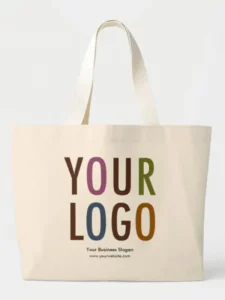
Still the most cost-effective method for medium-to-large runs with simple, bold artwork. Solid coverage. Sharp edges. Excellent washfastness. Best below six colors — every additional color adds a screen, a setup fee, and a registration step. For event giveaways, retail packaging, and corporate gifting at scale, this is the default for good reason.
Best for: 500+ unit runs, 1–4 color logos, bold typography, line illustration.
Trade-offs: not suited to photographic artwork, gradients, or fine tonal work.
Digital Printing (DTG) — Photoreal, Short-Run Friendly
Inkjet directly onto pretreated fabric. No screens, no setup minimums per color.
This is the method that unlocked low-quantity, full-color customization. Photographic images, complex gradients, hand-drawn illustrations with thousands of color values — all reproduce faithfully. The unit cost stays flat regardless of color count, which makes it ideal for short runs, sample drops, and SKUs with constantly changing artwork. Lighter hand-feel than screen print; slightly less abrasion-resistant on heavy-use bags.
Best for: photographic artwork, sub-500 runs, frequent design changes, e-commerce drops.
Trade-offs: unit cost higher than screen print at scale; works best on lighter, smoother canvas.
Sublimation — All-Over Color, Edge to Edge
Heat-activated dye that bonds into synthetic fibers rather than sitting on top of them.
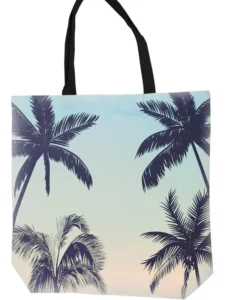
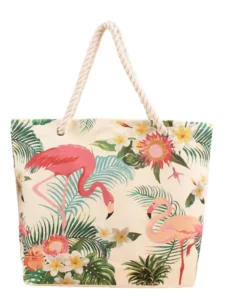
Sublimation is how you achieve true all-over printing — patterns that wrap from front panel across the gusset to the back, with no white space, no print boundary. Colors are vibrant and permanent. The catch: the process requires polyester or poly-blend canvas. 100% cotton won’t accept sublimation dyes, so material selection happens upstream of the artwork decision.
Best for: all-over patterns, edge-to-edge prints, vibrant gradients, photographic backgrounds.
Trade-offs: requires synthetic-blend canvas; not compatible with pure cotton.
Embroidery — Stitched, Not Printed
Thread, not pigment. The design is sewn into the fabric.
Embroidery doesn’t fade, doesn’t crack, doesn’t wash off — because there’s nothing to wash. The texture adds tactile weight and premium perception that no print method matches, which is why luxury retailers, corporate gifting programs, and heritage brands return to it for crests, monograms, and small-format logos. Less suited to large fill areas or fine detail; thread has a minimum line width and ignores it at its peril.
Best for: logos under 10 cm, monograms, crests, premium gifting, heritage positioning.
Trade-offs: higher unit cost; not suited to large coverage or photographic detail.
Hand-Painted — One of One
Brush, pigment, human hand.
There is no faster way to communicate craft, exclusivity, and limited-edition status than visible brushwork. Each bag becomes genuinely unique. We commission hand-painted runs for art-edition launches, gallery merchandise, fashion-week capsule drops, and ultra-VIP gifting where the recipient list is short and the production budget supports the labor. Not a method for scale — and that’s precisely the point.
Best for: limited editions, art collaborations, VIP gifting, gallery and museum merch.
Trade-offs: highest unit cost; long lead time; not for runs above ~100 units.
Photo Transfer — High-Fidelity Imagery, Specialized Use
Heat-transferred photographic film bonded to the canvas surface.
When the artwork is a real photograph — wedding portraits, pet pictures, archival imagery, personalized gifting — photo transfer delivers the cleanest, most faithful reproduction available. Image quality rivals print; the surface feels distinct from the surrounding canvas (a thin, smooth film rather than a porous weave). Suited to personalization programs, memorial pieces, and any product where the photo is the product.
Best for: personalized gifting, photo merchandise, memorial and family pieces, on-demand SKUs.
Trade-offs: distinct surface hand; lower abrasion resistance than screen or sublimation.
Custom Logo Printing & Custom Print — Method Agnostic, Brand-First
For most B2B clients, the question isn’t “which method” — it’s “which method best serves my logo, my quantity, and my budget.”
Our Custom Canvas Bags with Logo and Custom Printed Canvas Tote Bag programs cover that conversation. We start from artwork, pull color counts, evaluate fabric, project quantities — then recommend the right combination of methods (often two together, e.g. embroidered logo + screen-printed slogan). The method serves the brief; the brief never bends to fit a single method.
Method at a Glance
| Method | Best Artwork | Run Size | Hand-Feel | Cost Curve |
|---|---|---|---|---|
| Screen Printing | 1–4 color logos, bold graphics | 500+ | Slight raised film | Low at scale |
| Digital (DTG) | Photographic, gradient, complex | 50–500 | Soft, integrated | Flat across colors |
| Sublimation | All-over, edge-to-edge patterns | 200+ | None (dyed into fiber) | Medium |
| Embroidery | Logos, monograms, crests | 50+ | Textured, premium | Higher |
| Hand-Painted | Art editions, one-of-one | 10–100 | Brushwork visible | Highest |
| Photo Transfer | Real photographs, personalization | 1–500 | Smooth film surface | Per-unit |
How to Choose
Start from artwork, not method. Bold, low-color logo? Screen print. Photograph? Digital or photo transfer. All-over pattern? Sublimation. Crest or monogram? Embroidery. The artwork dictates the technique.
Match method to quantity. Setup-heavy methods (screen, sublimation) reward high quantities. Setup-light methods (digital, photo transfer) win at low quantities and frequent design changes.
Don’t ignore the fabric. Sublimation needs polyester. Embroidery prefers mid-to-heavy canvas (8 oz+) that supports the stitch density. Screen print is fabric-agnostic. Bring the substrate decision into the conversation early — not after artwork is approved.
Consider mixing methods. Some of our best-performing programs combine two techniques on a single bag: embroidered logo + screen-printed campaign slogan, or sublimated pattern + photo-transfer name tag. Mixing methods costs more per unit but delivers richer perceived value.
Sample before committing. Color shifts. Hand-feel differs. Lightfastness varies. A pre-production sample on the exact canvas, in the exact decoration method, removes 90% of post-shipment surprises.
Want to compare methods side-by-side before deciding? Request a Decoration Sample Pack → — same logo, multiple methods, shipped for hands-on evaluation.